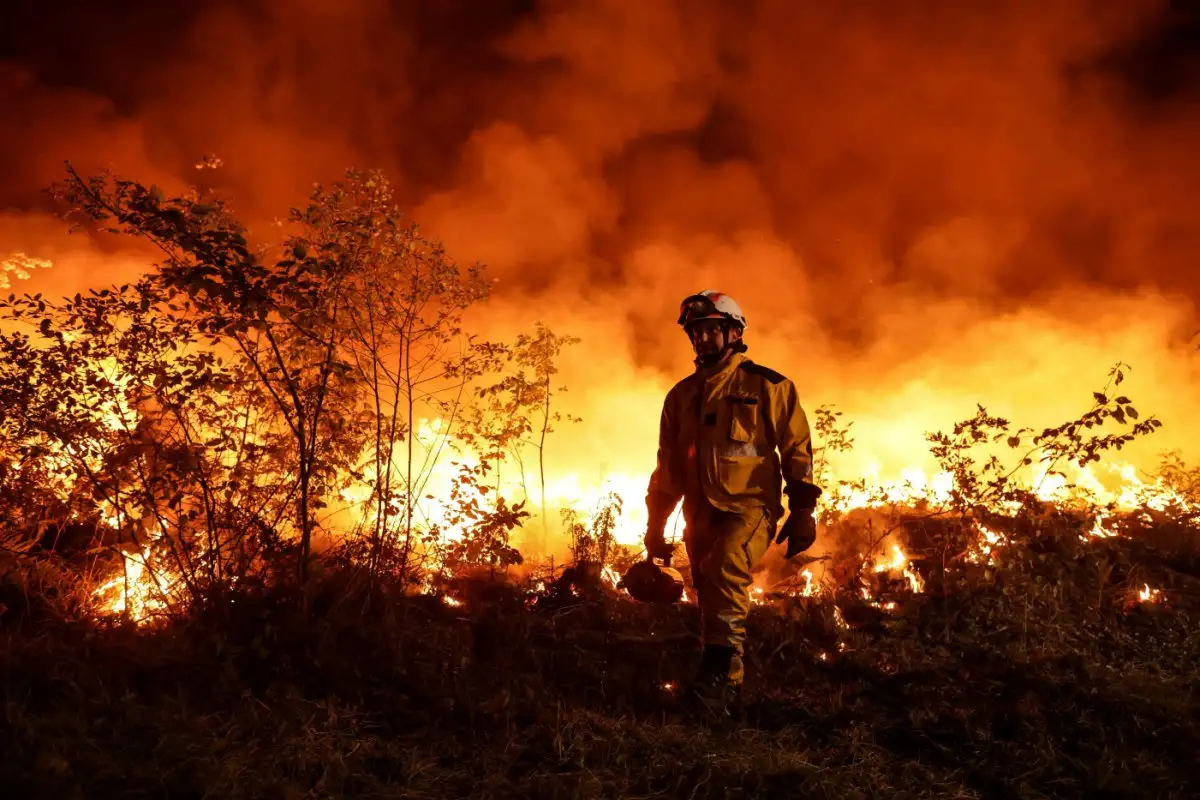
Record heat and a warming climate are turning southern Europe’s summers into a lengthening wildfire season.
Southern Europe is burning again. Wildfires have spread across Portugal, Spain, France, and Greece, forcing thousands from their homes and scorching an area more than twice the size of Manhattan.
The fires arrived on the heels of one of the continent’s worst heatwaves on record. Behind the flames sits a well-documented pattern that scientists have tracked for years, one that connects rising temperatures, drier land, and a changing climate to fire seasons that grow longer and more destructive with each passing summer.
The immediate driver is heat combined with dryness. A record-breaking heatwave in June left much of Europe’s vegetation, in the words of forecasters, tinder dry. When temperatures climb past 40 degrees Celsius and soil moisture drops, plants lose water and become highly flammable. Add wind and a single ignition source, and fires spread quickly across the landscape.
Why Europe wildfires are becoming more frequent
The science behind this is settled in its broad strokes. Research published in Nature Communications found that burned area in Mediterranean Europe is projected to increase as global warming rises, ranging from roughly 40 percent to 100 percent more depending on how much the planet heats. A 2020 review in the Annals of Forest Science concluded that wildfire danger and burned area should increase across southern Europe over the century, with fire-prone conditions expanding northward and into Mediterranean mountains that were previously too wet to burn.
The role of human-caused warming is direct. The World Weather Attribution group found that June’s heatwave, during which thousands of excess deaths were recorded, would have been virtually impossible without climate change from burning fossil fuels. Europe is the fastest-warming continent on Earth, having warmed by around two degrees in the 50 years since the historic heatwave of 1976, according to the World Meteorological Organization.
The current fires are part of a trend that data makes clear. According to the European Forest Fire Information System, major fires have increased every year since 2017. That year remains the worst this century, with over 988,000 hectares burned across the EU. It was followed by 2022, the second worst, when fires scorched more than 837,000 hectares, an area about the size of Montenegro. In 2023, more than half a million hectares burned, including the largest single wildfire recorded in Europe since the 1980s, a blaze near Alexandroupoli in Greece that burned over 96,000 hectares.
The human toll has been severe in specific years. Wildfires killed 66 people in Portugal in 2017, and a fire in the Greek seaside town of Mati claimed 104 lives in 2018. Even in 2024, a milder year with 383,317 hectares burned, the number of fires reached more than four times the 17-year average. The pattern is not that every year sets a record, but that the underlying conditions producing large fires are appearing more often.
How climate change is reshaping Europe’s environment
The effects reach well beyond the fires themselves. The European Environment Agency reports that rivers, lakes, and soils are drying out, putting pressure on water supplies, agriculture, and ecosystems while raising fire risk. In 2023, floods, droughts, heatwaves, and wildfires caused over 45 billion euros in damages across 38 European countries. Present wildfire damage, estimated at 2.4 billion euros a year, could nearly double with warming of 3 degrees or more.
The landscape itself is changing. A 2026 study in the journal Science projected that increasing wildfires and other disturbances will lead to a decline in old forests and a rise in young forests, particularly in the Mediterranean, with consequences for biodiversity and the carbon those forests store.
Wildfires also release large amounts of planet-warming gases and destroy carbon sinks, which in turn feeds the warming that makes future fires more likely. Spain has recorded record-low soil moisture and mounting pressure on its reservoirs, and sea surface temperatures around Europe have reached record highs for this time of year.
What Europe’s wildfire season means for daily life
The human cost is visible in everyday routines. During the June heatwave, France recorded its hottest day on record and issued red alerts across most of the country. Germany saw 252 weather stations break all-time records, and health authorities there reported hundreds of heat-related deaths. France reported school closures, cancelled outdoor events, and rail disruptions as heat expanded train tracks, while emergency medical calls rose sharply. In the current fires, more than 10,000 residents were evacuated near Perpignan in southwestern France, and organisers banned spectators from a stage of the Tour de France because of a nearby blaze.
Tourism, central to the economies of southern Europe, is adapting. Extreme heat and wildfires have become a factor travelers weigh when choosing where and when to visit. Destinations have rolled out multilingual emergency alert systems, including the pan-European MeteoAlarm platform, that push real-time warnings about fires and heat directly to visitors’ phones. Energy systems are strained too, with cooling demand at its highest level in at least 45 years and concerns over reduced output from French nuclear plants that rely on river water for cooling.
Governments are shifting their approach in response. Portugal, hit hard in 2017, raised the share of its fire budget spent on prevention from 20 percent in 2017 to 61 percent in 2022. The EU has reinforced its shared firefighting fleet through the Civil Protection Mechanism, deploying water-bombing aircraft across borders during peak season. Scientists describe the trend as structural rather than seasonal, and modelling suggests Europe could face up to a tenfold increase in extreme fires in a warming climate.
Research points to prevention, from restoring ecosystems to managing forests differently, as central to reducing the damage. The forces driving southern Europe’s fires are measurable, documented, and, according to the research, set to continue as long as the climate keeps warming.