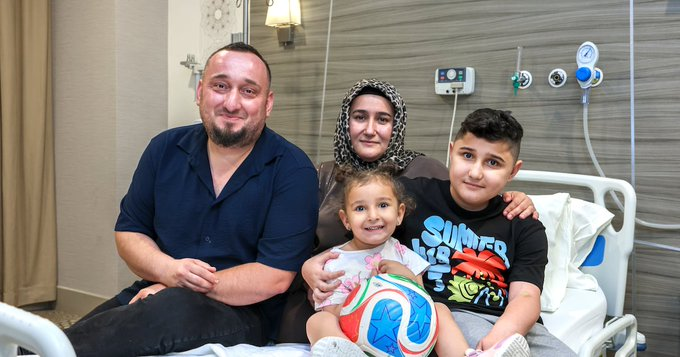
A nationwide fundraising campaign in Turkey helped an 11-year-old reach life-changing treatment in Abu Dhabi.
An 11-year-old Turkish boy with Duchenne muscular dystrophy has begun a 2.8 million dollar gene therapy in Abu Dhabi, after thousands of people across Turkey raised the money to fund it. Yigit Elma has been admitted to Burjeel Medical City, where he will become the first Duchenne muscular dystrophy patient to receive gene therapy at the hospital. The treatment, one of the most expensive in the world, cannot cure the condition, but it can slow its progression.
Yigit’s family could not afford the cost of the treatment on their own. His diagnosis united communities across Turkey, where neighbours, businesses, sports clubs, and strangers organised charity matches, auctions, and community events to raise the full amount. The football-loving boy became the focus of a nationwide effort that gave him a chance at care unavailable in his home country.
“Our community and our country stood beside us throughout this journey,” Yigit’s father said, adding that people who had never met the family helped their son. With the money raised, Yigit travelled to Abu Dhabi and was admitted to Burjeel Medical City, one of only a few centres in the UAE approved to offer the therapy.
Before treatment could proceed, doctors screened Yigit for antibodies that can block the safe delivery of the therapy. He tested negative, which made him eligible to receive it. A multidisciplinary team is now reviewing his case and planning the treatment.
What Duchenne muscular dystrophy gene therapy involves
Duchenne muscular dystrophy is a rare inherited condition that gradually weakens the muscles. It occurs in about 1 in every 3,500 to 5,000 male births worldwide and almost exclusively affects boys. Children with the condition often begin life walking and playing normally, but over time actions like climbing stairs, running, or standing become harder. Without timely care, many lose the ability to walk and later develop breathing and heart complications.
The therapy Yigit is receiving, called Elevidys, is a one-time gene therapy available in the UAE and a small number of other countries. Doctors explain that it helps the body produce a shorter but functional form of dystrophin, a protein that muscles need to stay strong. The treatment cannot reverse existing muscle damage, but it can slow further muscle loss. Timing is especially important for children who can still walk, which is why early intervention matters.
The therapy was approved by the US Food and Drug Administration in June 2023. According to Professor Ayman El-Hattab at Burjeel Medical City, without treatment the condition continues to deteriorate, making access to the therapy significant for eligible patients.
The UAE as a growing hub for gene therapy
Yigit’s case reflects a wider pattern of families travelling to the UAE for advanced genetic treatments. The country has positioned itself as a regional destination for gene therapies that were previously available only in the United States. In 2024, the Department of Health in Abu Dhabi delivered Duchenne muscular dystrophy gene therapy for the first time outside the US, at Sheikh Khalifa Medical City.
Other hospitals across the UAE have expanded similar services. Facilities in Dubai and Abu Dhabi now treat patients with Duchenne muscular dystrophy and spinal muscular atrophy, another rare genetic disorder, and several have reported patients travelling from Turkey and elsewhere in the region for care. Over recent years, hospitals in the UAE have provided gene therapy treatments to children from multiple countries.
For families facing conditions with few options at home, the availability of these therapies in the UAE has offered a route to treatment that did not exist a few years ago. Yigit’s journey, funded entirely by community donations in Turkey and carried out in Abu Dhabi, brings together both the reach of that fundraising effort and the UAE’s growing role in advanced medical care. His treatment now moves forward under the hospital’s specialist team, marking another case in which the country has served as a destination for care that remains rare across much of the world.