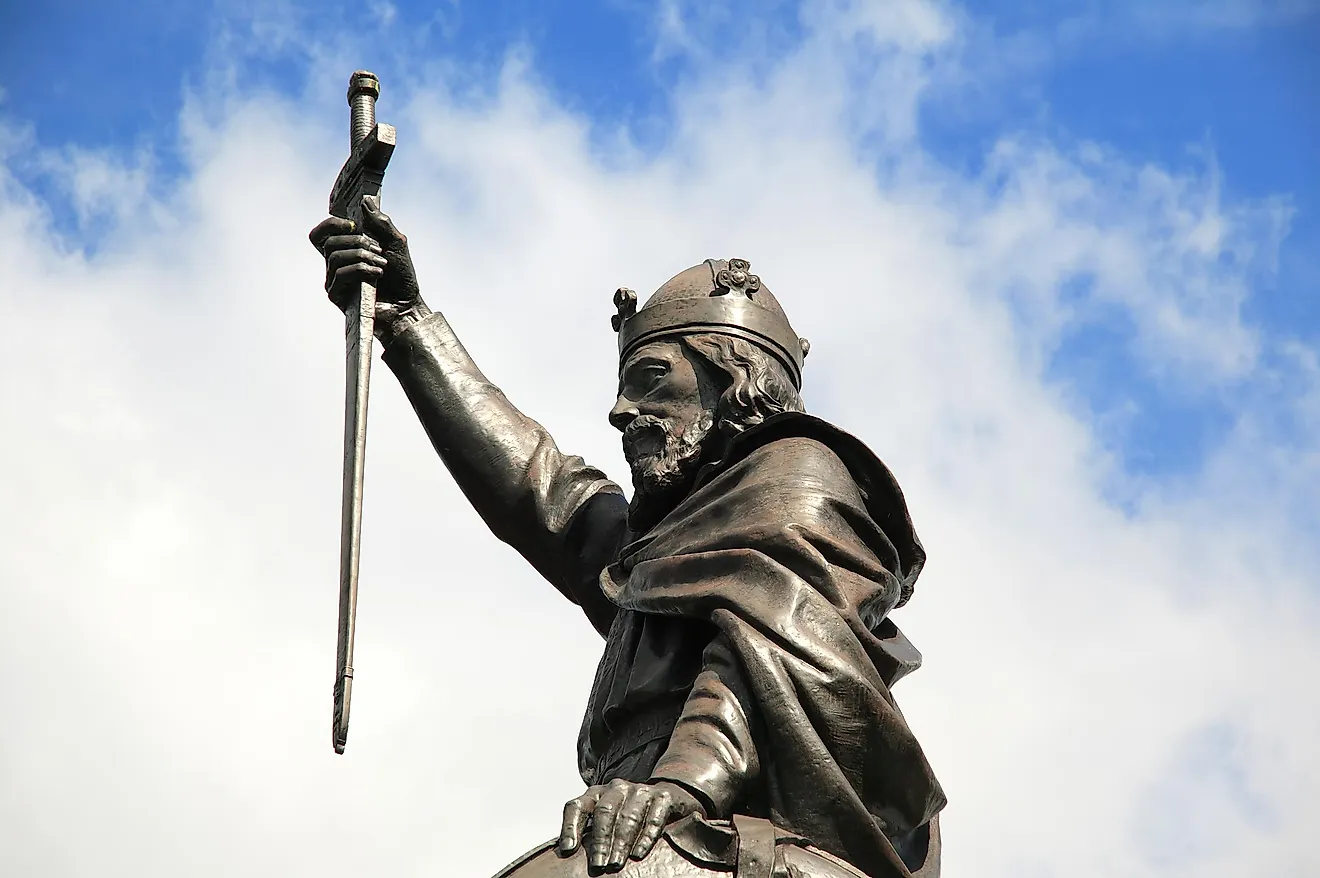
Could one of England’s greatest kings have spent centuries buried beneath a Winchester car park?
The lost remains of King Alfred the Great, the first king of a united England, may lie buried beneath a car park in Winchester, according to a historian who has spent 13 years searching for them. Author and researcher Graham Phillips says he has traced the grave of the Anglo-Saxon ruler to River Park, a car park in the Hampshire city where Alfred died and was first laid to rest. The claim was revealed on the British television series Weird Britain on Blaze TV on July 8, 2026.
Alfred the Great died in 899 and remains the only King of England to carry the title “the Great.” He earned his place in history through a decisive victory over Viking forces at the Battle of Edington in 878, after a surprise Norse assault had driven him into retreat in the fields of Somerset, where he rebuilt an army that ultimately forced the invaders to surrender.
His resting place, however, has been a mystery for centuries because his bones were moved repeatedly. Alfred was first buried in Winchester Cathedral until 1110, when his remains were transferred to Winchester’s Hyde Abbey and interred before the high altar, between the bodies of his wife and son. The abbey was demolished after the dissolution of the monasteries in 1539, leaving the site in ruins and the graves lost to record.
In 1866, during construction of a workhouse on the site, the antiquarian John Mellor excavated the area, believed he had found Alfred’s bones, and had them reburied at nearby St Bartholomew’s Church. For decades it was assumed the remains had either been recovered or destroyed during that construction work.
King Alfred the Great car park discovery investigation
The modern search gained momentum in 2013, when archaeologists exhumed and carbon-dated the bones from St Bartholomew’s churchyard. The results showed they dated from more than 200 years after Alfred’s death, meaning they could not be his. That finding sparked the researcher’s interest and set him on his own 13-year investigation.
His breakthrough came last summer while examining documents at Cambridge University. There he uncovered an article written by the historian Henry Howard, published in the journal Archaeologia in 1800. The document revealed that in 1788, when a prison was built next to the Hyde Abbey site, the area holding the graves was converted into a garden for the warden’s residence. He believes the bones of Alfred, his wife, and his son were moved decades before the 1860s workhouse construction, contradicting the long-held assumption that they were lost at that time.
Based on that evidence, he concludes the remains now lie about 20 yards from the stone slabs in a scenic Winchester garden that were placed to mark where Alfred, his wife, and his son were once thought to be buried. Winchester City Council had turned the Hyde Abbey site into that garden on the presumption the bones had perished in the 1860s.
King Alfred the Great and the Richard III car park parallel
The claim carries clear echoes of one of Britain’s most famous archaeological finds. In 2012, the remains of King Richard III were discovered beneath a car park in Leicester and later confirmed through DNA analysis, a discovery that captured global attention. The announcement invites the same comparison, though the claim has not yet been tested through excavation or scientific analysis.
Graham Phillips, a 72-year-old historian from Birmingham, has also noted the timing of the announcement, drawing a parallel between Alfred’s triumph over the Vikings and an approaching England football fixture against Norway. Whether the theory holds will depend on future excavation and dating work at the site, which has not yet taken place.
He has called for excavation at the River Park site to test the theory. Any confirmation would require exhumation and scientific analysis, including carbon dating and possible DNA comparison, none of which has yet been carried out. The bones marked at the Hyde Abbey garden remain the officially recognised site connected to Alfred, his wife, and his son.