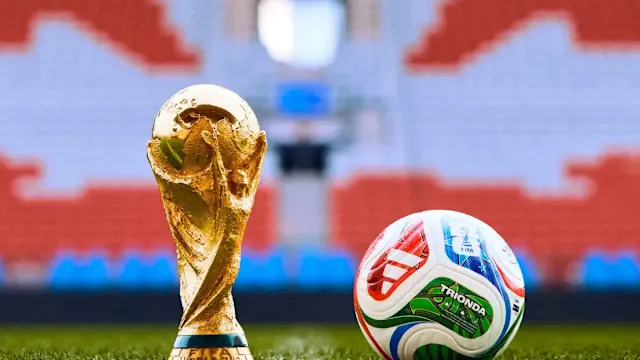
The FIFA World Cup 2026 has reached the quarterfinal stage, as the final eight teams prepare to do battle. These teams may not be the best eight among the 48 qualifiers, but they are good enough to make you wait for these matches and to pray for their success.
On one hand, there is the rematch of last World Cup’s semifinal between favorites France and Morocco, followed by Spain versus Belgium, England versus Norway, and Argentina versus Switzerland, all this weekend.
Despite these teams’ ascent, many believe the World Cup is too controversial, and they might have a point. Last night, the referees’ issuance of yellow cards to Egypt’s players and head coach for demanding a legitimate VAR review was poor optics for the game, as was American President Donald Trump’s ‘order’ the day before to overturn a ban on one of his team’s star players.
That’s not all; the Paraguay versus France match was one of the most ill-tempered games (mostly due to Paraguayan players), yet the referee didn’t issue a single yellow card to any of them. In fact, three French players received yellow cards, adding another controversy to the ever-growing list.
If they can hand yellow cards to the Egyptian players after the match against Argentina for demanding what was their right to question a decision, why wasn’t one issued to the Paraguayan goalkeeper who deliberately threw a ball at the celebrating French captain Kylian Mbappe? Beats me.
The hydration breaks are also an American-made addition to the game that might have helped England and Argentina win matches from seemingly impossible situations, but they disrupt the tempo of a match that already has a half-time at 45 minutes. Yes, the hydration break must be taken, but only in cities where the temperature is over 32 degrees centigrade, not in fully air-conditioned stadiums where there is no need for such a break.
In fact, the crowd showed their displeasure during one match by booing when the hydration break was announced, whereas in another, when it wasn’t taken due to a forecast of rain, it was cheered on social media. That shows you that FIFA is wrong on many counts this time.
Which team has the best chance to reach the semifinals?
Among the eight teams that have qualified for the quarterfinals, four have won the World Cup, and four haven’t. Argentina is the defending champion, having won the event in 1978 and 1986. France has won the tournament twice (1998 and 2018), and England (1966) and Spain (2010) have each won once.
Among the quarterfinalists, the teams that have never won the World Cup include Morocco, Belgium, Norway, and Switzerland. While Belgium and Morocco have advanced beyond the last eight, with Belgium winning third place in 2018 and Morocco claiming fourth in 2022, this is the farthest Norway and Switzerland have reached in the FIFA World Cup.
Erling Haaland’s Norway might seem to be in the best form, but Switzerland can’t be rated any lower, especially given their track record. They reached the quarterfinals of the second, third, and fifth FIFA World Cups, and their current run to the last eight is their first in 72 years! If any of these teams reach the semifinals, it will be a major boost for their countrymen in general and for football in their country in particular.
My prediction would be a France-Spain semifinal and an England-Argentina matchup in the other. France because Mbappe is in the form of his life; Spain because they have given other teams tough times in the tournament so far; England for Harry Kane and Co.; and Argentina because of Lionel Messi and his spirited boys.
Lionel Messi leads the race for the Golden Ball
On paper, it might seem like a battle where Argentina (South America) and Morocco (Africa) stand against Europe’s best; in reality, it is a battle between the best players in the world. If you can score or assist on a goal, your team wins; if you can’t, you lose.
To celebrate this achievement, the Golden Ball award is presented to the best footballer at the FIFA World Cup, based on the most goals scored. In the last three tournaments, the award went to Argentina’s Lionel Messi twice (2014 and 2022), while in the 2018 World Cup, it was Croatia’s Luka Modric who took the prize.
Who are the players with the most goals this year? The list features Argentina’s Lionel Messi in first place with eight goals, followed by the French captain Kylian Mbappe and Norwegian star Erling Haaland, each with seven goals.
English captain Harry Kane is also in the running with six goals, followed by countryman Jude Bellingham, who has scored four goals to stay in the race with France’s Ousmane Dembele and Spain’s Mikel Oyarzabal.
You can’t forget Belgian star Romelu Lukaku, Moroccan Ismael Saibari, and Switzerland’s Johan Manzambi from the race as well, because they are the only active players with three goals to their names and have the skill to add more to their tally.
What’s interesting is that the number could have been ten for Messi, who missed not one but two penalties at the mega event!